Can You Actually Fix Bad Posture?
‘Sit up straight.’ You heard it as a child, you tell yourself every day, and you probably have a posture corrector sitting unused in a drawer somewhere. The problem isn’t your willpower — it’s that most posture advice doesn’t address what’s actually causing the problem.
Bad posture is not a bad habit you can correct through awareness alone. It’s a neuromuscular pattern — a combination of tight muscles, weak muscles, restricted joints, and habituated motor programs — that requires active intervention to change. Here’s what actually works.
What Is ‘Bad Posture,’ Really?
The most common postural pattern we see in clinical practice — particularly in adults who sit for work — is the ‘Upper Crossed Syndrome’ (UCS), described by Dr. Vladimir Janda:
- Tight: Pectorals, anterior cervical muscles, upper trapezius, levator scapulae
- Weak: Deep cervical flexors, lower trapezius, serratus anterior, rhomboids
The result: rounded shoulders, forward head, thoracic kyphosis, and loss of cervical lordosis. The second common pattern, ‘Lower Crossed Syndrome’:
- Tight: Hip flexors, thoracolumbar extensors
- Weak: Abdominals, glutes
Result: anterior pelvic tilt, exaggerated lumbar lordosis, reduced hip extension. Many patients have both patterns simultaneously.
Why Posture Correctors Don’t Work Long-Term
Posture braces and correctors do one thing: passively hold your body in a position. They do not strengthen the muscles that need to be strengthened, release the muscles that need to be released, or retrain the nervous system’s postural programs. When you take them off, you return to exactly the same pattern — and in some cases, the passive support has made your own muscles weaker.
They’re not entirely useless — a brace worn for 20 minutes as a training cue while doing corrective exercises can be helpful. But a brace worn passively for 8 hours is a posture band-aid, not a posture correction.
The Four Components of Effective Posture Correction
1. Joint Mobilization
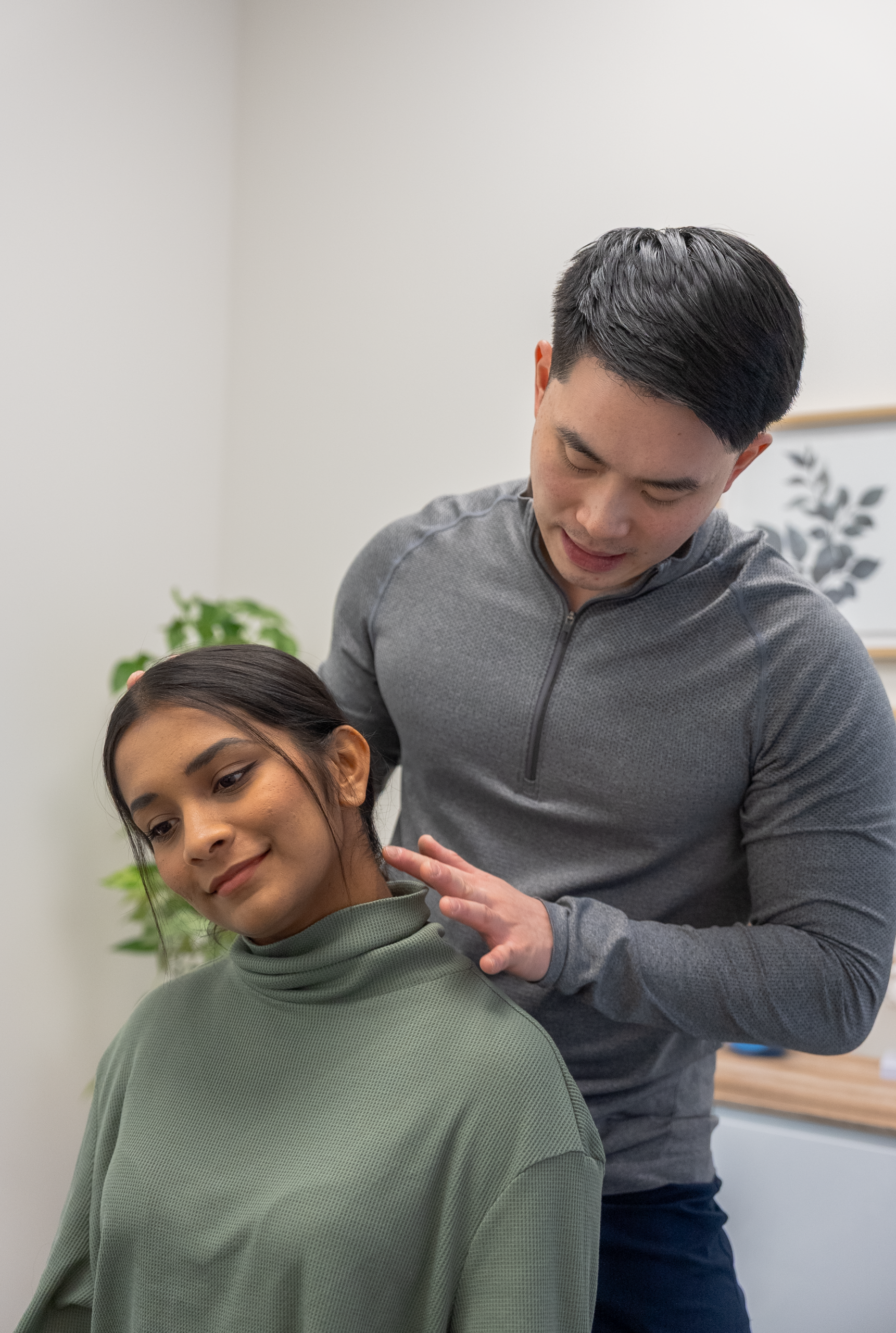
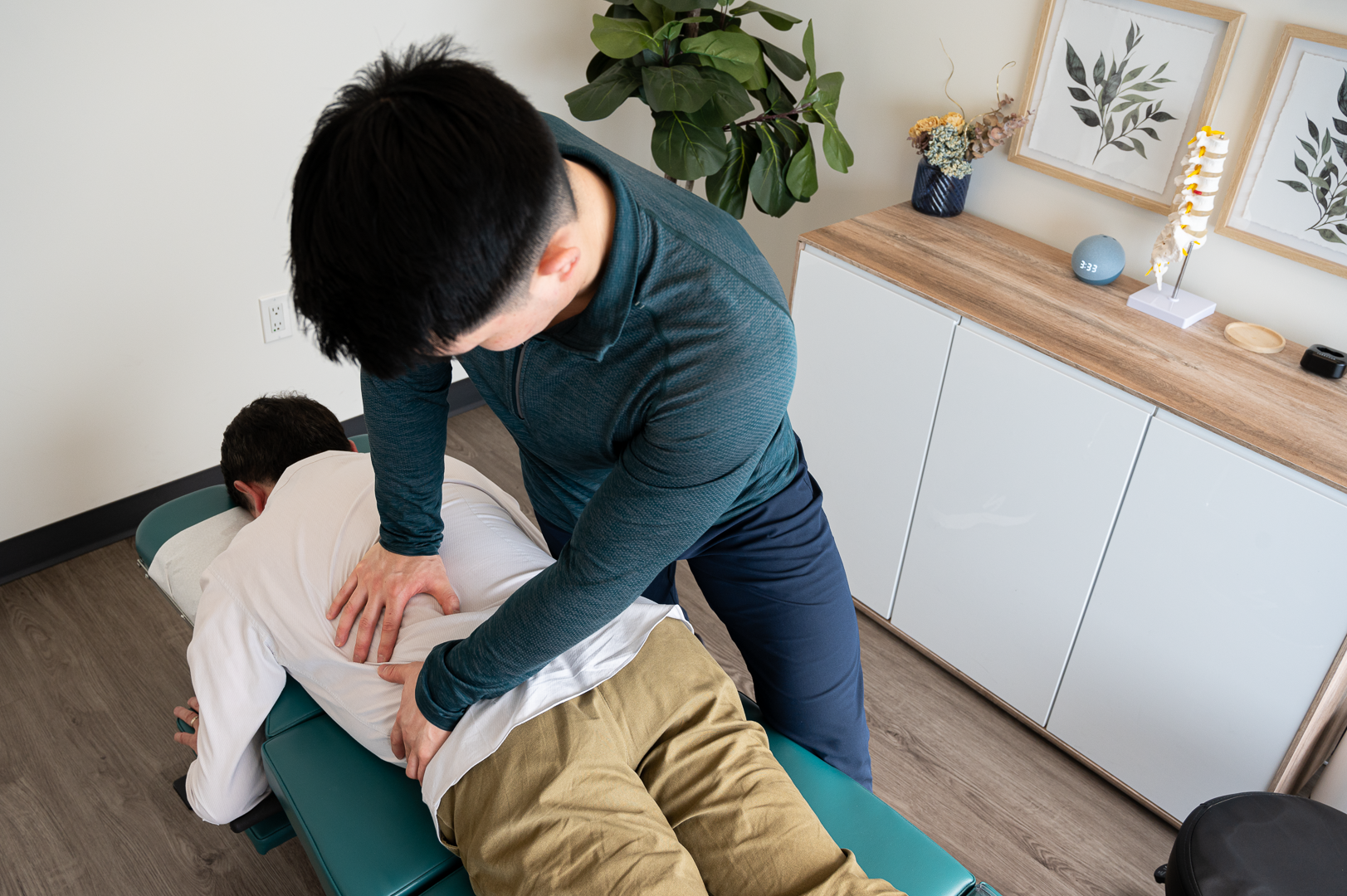
Tight, restricted joints — particularly in the thoracic spine and upper cervical region — physically prevent correct posture. No amount of exercise changes a joint that won’t move. Chiropractic mobilization restores the available range of motion that makes good posture mechanically possible.
2. Soft Tissue Release
The tight muscles of UCS — particularly pectorals, upper traps, and suboccipitals — need to be manually released before strengthening work can effectively change postural resting position. Registered Massage Therapy at Axon Chiropractic and Rehab directly addresses these tissue restrictions.
3. Targeted Strengthening
The muscles that have become inhibited and weak must be progressively loaded to change the neuromuscular balance. The key exercises for UCS correction:
- Deep cervical flexor strengthening: Chin tucks with progressive resistance — the most important exercise for forward head posture.
- Scapular retraction and depression: Rows, face pulls, and prone Y/T/W exercises for lower trap and rhomboid activation.
- Serratus anterior: Wall slides and push-up plus to correct winging scapula.
- Thoracic extension: Foam roller thoracic extension, wall angels.
4. Movement Pattern Retraining
Posture is dynamic, not static. The goal is not to maintain a perfect static position — it’s to move through your day with good mechanics. This means retraining how you sit, stand, walk, and carry loads — addressing the habituated patterns that maintain the poor posture despite improved strength.
How Long Does Posture Correction Take?
Realistic expectations are important here:
- Noticeable improvement: 6–8 weeks of consistent corrective exercise and treatment
- Significant change in resting posture: 3–6 months
- Deep neuromuscular reprogramming: 6–12 months of maintenance
Posture developed over years cannot be fixed in weeks. What patients often report, however, is that pain decreases significantly within the first few weeks even before postural change is visible — because the muscular and joint drivers of pain are improving before the structural change is apparent.
What Your Chiropractor Actually Does for Posture
At Axon Chiropractic and Rehab, our posture correction approach consists of:
- Comprehensive postural assessment: We assess your resting posture and identify your specific imbalance pattern — not a generic ‘you have bad posture’ observation.
- Joint mobilization: Thoracic spine, cervical spine, and rib cage — the regions most restricted by sustained flexion postures.
- Muscle work coordination with RMT: Pectoral release, cervical soft tissue work, and shoulder girdle treatment.
- Evidence-based exercise prescription: A specific, progressive home program targeting your identified weaknesses.
- Ergonomic coaching: Your posture during 40+ work hours per week matters more than 20 minutes of exercise. We address your workspace, sleeping position, and daily movement patterns.
Frequently Asked Questions
Ready to find out how to improve your posture?
Axon Chiropractic and Rehab in North York offers honest, evidence-based chiropractic care with clear treatment plans. Book your first chiropractic assessment today — and leave with a clear picture of what to expect.
Address: 200 Consumers Rd Suite 120, North York, ON M2J 4R4 (Victoria Park & Sheppard — easy access from Hwy 401 & 404 & the Parkway Forest Community)
Phone: 416-901-2966