
Tech Neck is Real — Here’s How to Fix It
Cast your eyes around any public space in North York — the subway, a coffee shop, a waiting room — and you’ll see the same scene: heads tilted down, eyes fixed on screens, shoulders rounded forward. This posture has become so ubiquitous we barely register it. But physiologically, it is placing extraordinary stress on the cervical spine — stress that causes a syndrome any acute neck pain chiropractor in North York now sees daily.
If you’ve ever ended a long day at your desk — or a long scroll on your phone — with a stiff, aching neck, you’ve likely experienced tech neck. It might sound like a buzzword, but it’s a very real musculoskeletal condition that chiropractors across Canada are seeing at record rates.
The good news? Tech neck is both preventable and treatable. Here’s everything you need to know.
What Is Tech Neck?
Tech neck (also called forward head posture) refers to the strain placed on the neck and upper spine when you tilt your head forward and downward to look at a screen or device. It’s not just about discomfort — it’s a biomechanical problem with real consequences.
Here’s the physics: your head weighs roughly 10–12 lbs in a neutral position. For every inch your head tilts forward, the effective load on your cervical spine doubles. At a 45-degree angle (pretty typical when scrolling), your neck is managing the equivalent of 50 lbs of force.
Do that for hours every day, and you’ve got a recipe for chronic pain.
Signs and Symptoms of Tech Neck
Tech neck doesn’t always announce itself with dramatic pain. Watch for these warning signs:
- Persistent neck stiffness, especially in the morning or after screen time
- Headaches that originate at the base of the skull
- Upper back and shoulder tightness or a “rounded shoulder” appearance
- Tingling or numbness down the arms or into the hands
- Reduced range of motion — difficulty turning your head fully left or right
- Jaw tension or TMJ discomfort
If you’re experiencing several of these together, it’s worth having your spine assessed by a professional.
Why Tech Neck Is Getting Worse
Canadians now spend an average of 11 hours per day in front of screens — between smartphones, laptops, tablets, and televisions. Remote and hybrid work has extended desk hours, and social media has made prolonged phone use the norm.
The result is that tech neck is no longer a condition affecting only desk workers. We’re seeing it in students, teenagers, and even children as young as 8 or 9.
Long-Term Consequences If Left Untreated
What starts as occasional stiffness can progress into more serious issues if tech neck goes unaddressed:
- Cervical disc herniation — compressed discs can bulge or rupture over time
- Degenerative disc disease — accelerated wear on the cervical vertebrae
- Muscle imbalances — weakened deep neck flexors and chronically overloaded upper trapezius
- Nerve impingement — leading to radiating arm pain or chronic headaches
The earlier you address tech neck, the easier it is to correct.
How to Fix Tech Neck: A Multi-Pronged Approach
1. Ergonomic Adjustments
Start by changing your environment to support better posture:
- Raise your monitor so the top of the screen is at or just below eye level
- Hold your phone at eye level rather than looking down at it
- Use a document holder when reading at your desk
- Consider a standing desk or laptop riser
2. The 20-20-20 Rule (Plus Neck Reset)
Every 20 minutes, take a 20-second break and look at something 20 feet away. Add a simple neck reset: sit tall, gently tuck your chin back (like making a “double chin”), hold 5 seconds, and release. This realigns your cervical spine and relieves accumulated tension.
3. Targeted Stretches and Exercises
A consistent routine of stretching and strengthening can make a significant difference:
- Chin tucks — 3 sets of 10 repetitions daily to activate deep cervical flexors
- Levator scapulae stretch — tilt head to one side, rotate slightly, and hold 30 seconds per side
- Doorframe chest opener — stretches the pectoral muscles that tighten with rounded posture
- Wall angels — re-trains shoulder blade positioning and thoracic spine mobility
- Band pull-aparts — strengthens the posterior shoulder girdle
4. Chiropractic Care for Tech Neck
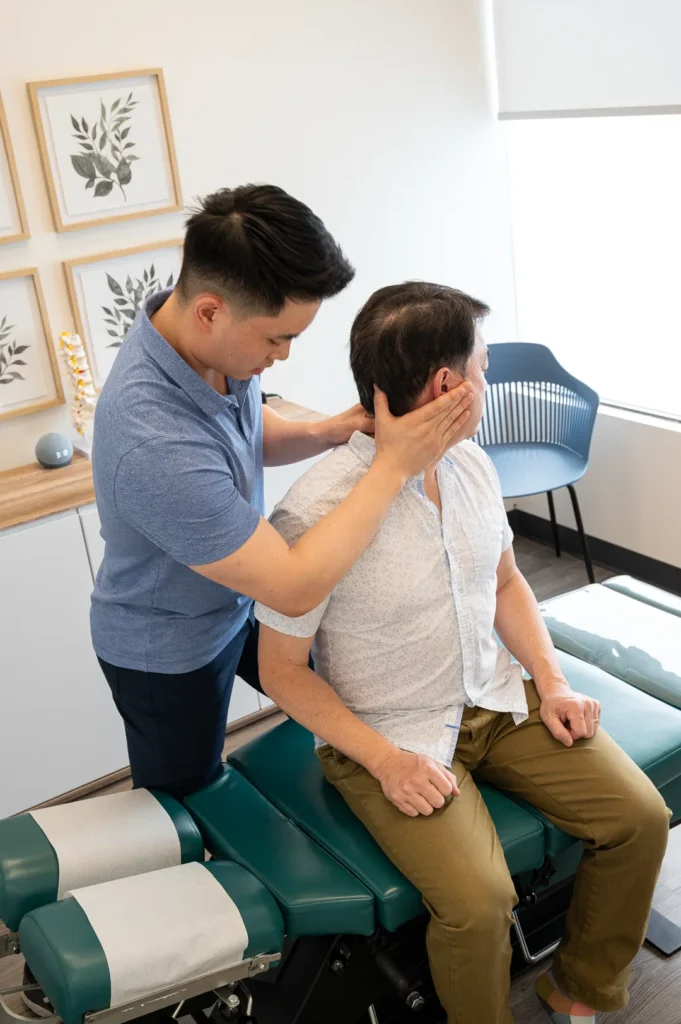
Exercises and ergonomics address the surface level, but chiropractic care gets to the structural root of tech neck. A chiropractor will:
- Assess your cervical alignment and identify restrictions or subluxations
- Use spinal manipulation to restore proper joint mobility in the neck and upper back
- Apply soft tissue therapy to release chronically tight muscles (trapezius, suboccipitals, scalenes)
- Create a personalized rehabilitation program to correct underlying imbalances
- Provide guidance on posture habits and workstation setup
Patients often notice significant relief within just a few sessions, with lasting results when combined with corrective exercises.
5. Massage Therapy
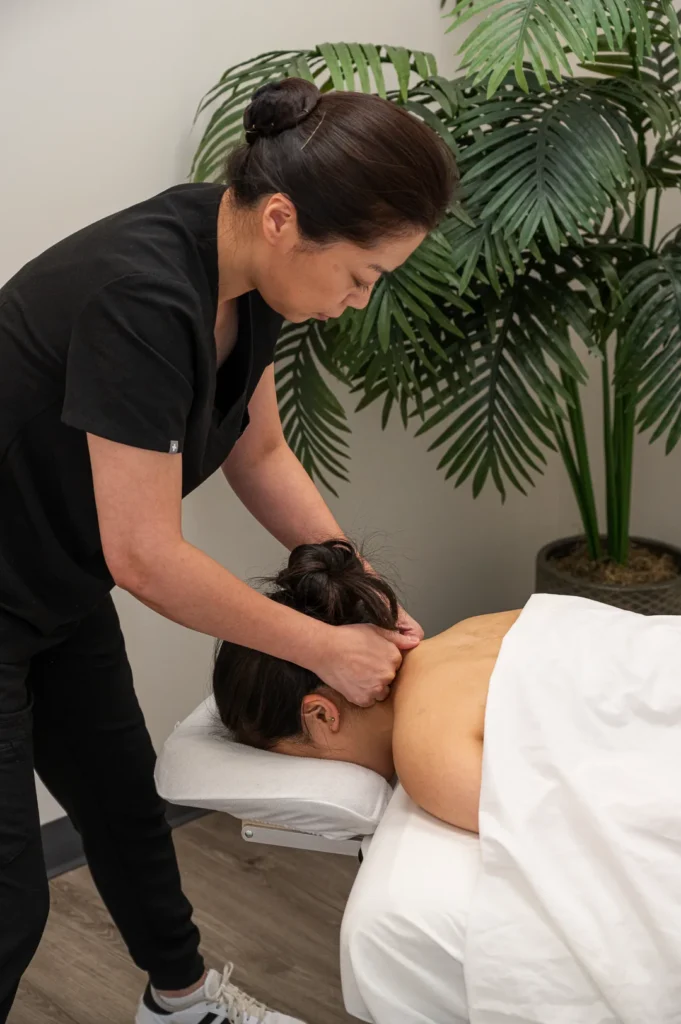
Registered Massage Therapy (RMT) is an excellent complement to chiropractic adjustments for tech neck. Targeted massage releases trigger points in the neck, upper back, and shoulders, reduces muscle guarding, and improves circulation to strained tissues.
When to See a Chiropractor for Tech Neck
Book an appointment if you’re experiencing:
- Neck pain or stiffness that has lasted more than a week
- Headaches that occur regularly, especially at the back of the head
- Tingling, numbness, or weakness in the arms or hands
- Noticeable changes in your posture (head jutting forward, rounded shoulders)
- Discomfort that disrupts your sleep or daily activities
Frequently Asked Questions
Don’t Wait Until It Gets Worse
Tech neck is one of the most common conditions we treat at Axon Chiropractic and Rehab in North York — and one of the most satisfying to resolve. With the right combination of spinal care, targeted exercise, and ergonomic adjustments, most patients see meaningful improvement quickly.
If your neck is telling you something, it’s worth listening to. Book a consultation with our team today and take the first step toward a pain-free posture.
Address: 200 Consumers Rd Suite 120, North York, ON M2J 4R4 (Victoria Park & Sheppard — easy access from Hwy 401 & 404 & the Parkway Forest Community)
Phone: 416-901-2966